

Asking the Kangaroo
Spiritual Protocol and the Act of Harvesting
CONTENTS
In much of the modern world, the act of harvesting an animal is understood primarily as a practical one. A resource is identified, a method is applied, and a product is obtained. The transaction begins and ends in the physical world.
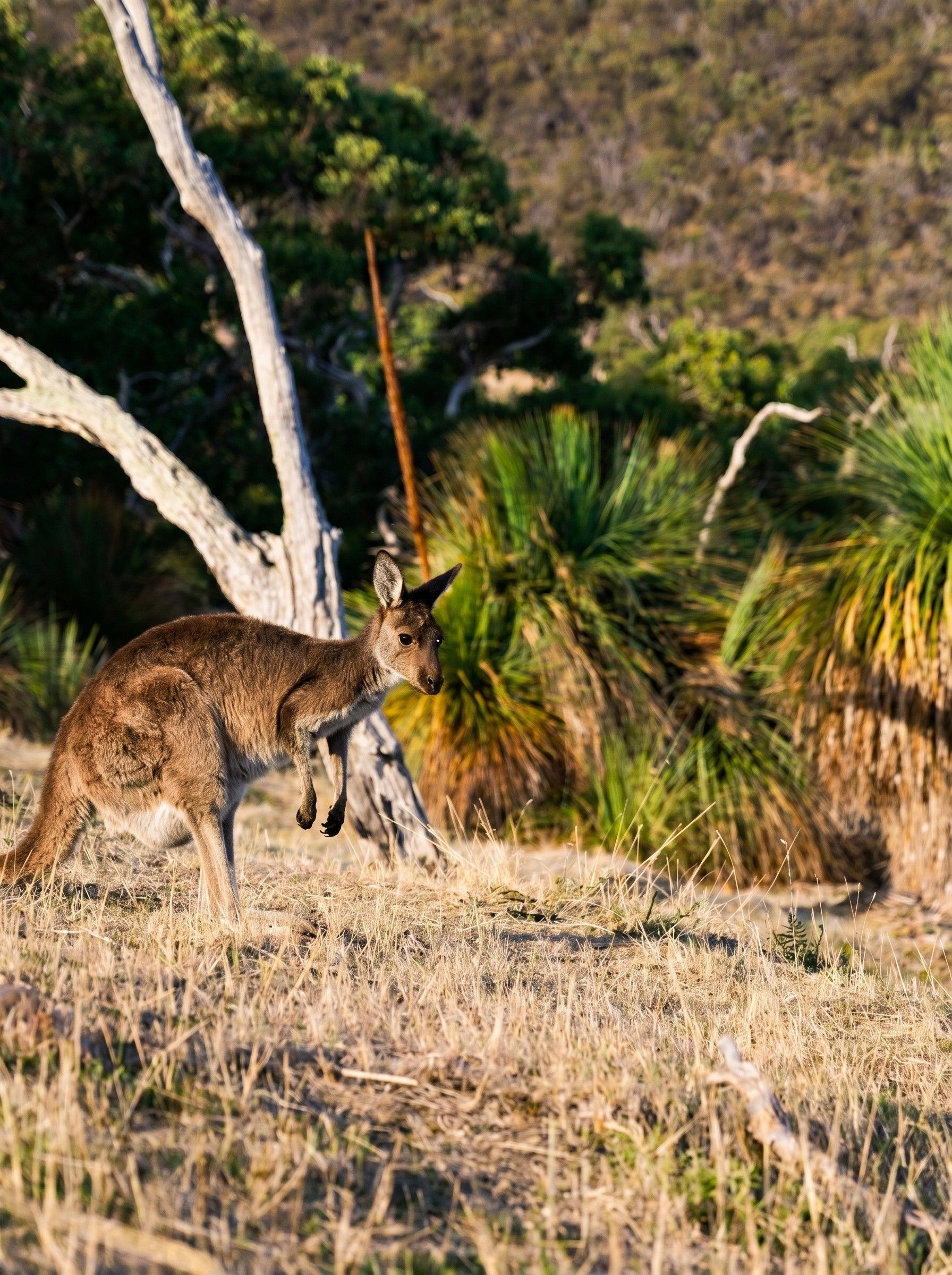
For Aboriginal people, it has never worked that way. The harvest of a kangaroo is not simply the taking of an animal. It is a moment embedded in a relationship that runs in both directions, one that carries obligations, gratitude, and a recognition that the life given deserves acknowledgement.
Mark Koolmatrie describes this spiritual dimension of harvesting with quiet clarity.
"Spiritually, you're asking that kangaroo to give its life for whatever purpose. That purpose might be to care for the environment. The purpose might be a food source. That purpose might be so many other reasons, but you're asking the kangaroo, and you're thanking it for giving up its life to be able to provide some economics for my family."
The words "asking" and "thanking" are not incidental. They are the whole point. The kangaroo is not taken. It is asked. And when it gives, gratitude is returned.
A Reciprocal Relationship
What Mark describes is not a ritual performed out of habit or obligation. It is a genuine articulation of a worldview in which people and animals exist in a state of ongoing reciprocity. The kangaroo gives. The people give back. And that exchange is what keeps the whole system in balance.
"You're saying, hey, thank you for giving your life. Now I'm able to survive the next week because I now have some income coming in. Thank you. I now have some food for the rest of the week. And so it has given its life for us to prosper."
But the relationship does not end with the harvest. The obligation flows in the other direction too, and it is one that Aboriginal people have honoured for as long as they have lived on this continent.
"We also give the kangaroos life so that they are protected and looked after by making sure that the environment is cared for, to ensure there's enough food sources, there's enough shelter. So we're giving to the kangaroo, and in return, the kangaroo is giving back to us."
This is the spiritual logic that underpins everything Mark has described across this series. The Ngartji system, the custodians who protect without eating, the careful management of country and environment, all of it flows from this central understanding: that the relationship between Aboriginal people and the kangaroo is one of mutual obligation, not one-sided extraction.
Country, Balance, and the Decision to Harvest
The spiritual protocol of harvesting is inseparable from the concept of country. For Aboriginal people, country is not simply land. It is a living system of relationships, a place of spiritual connection, responsibility, and belonging.
"The term country means an area that our people have a spiritual connection to. Many other people will use the word place. So those places that are significant to us as individuals. And that's just not a First Nations term, this word for place. It is about every single person who has a connection to place."
Caring for country is an active practice, not a passive one. And sometimes, caring for country means harvesting.
"The importance of country is so important. Because what happens, sometimes these kangaroos are eating out everything. So they need to be lessened, to be able to look after country. It's a balance of understanding everything in it, but also then the environment, which is a part of country."
This is a point worth sitting with. The decision to harvest is, in this framework, itself an act of care. When kangaroo numbers grow beyond what the land can support, reducing them is not a departure from the duty to protect country. It is the expression of it.
"By doing things, we're actually caring in so many different ways. But at the end of the day, it is all still caring for country and caring for place."
The Nomadic Principle: Taking Only What Is There
The spiritual commitment to reciprocity is also expressed in the way Aboriginal people have always approached the question of numbers. Harvest is never extraction to the point of depletion. It is calibrated, always, to what the country can sustain.
"We would never ever take out all kangaroos. Because by getting rid of kangaroos in one area, there are so many other jobs that the kangaroo does to improve our environment. So we're making sure that it's a skilled balance, between if there's an abundance, an overabundance, or if there's less of something there. We wouldn't go and get any food source."
The traditional nomadic lifestyle was itself a practical expression of this principle. When one area's food sources were diminished, Aboriginal people moved on, allowing the land and its animals to recover before returning.
"There is talk about our people being nomadic over the generations. So when the food source is lessened in one area, we move to another area and we let that previous one replenish. Then when we come back around, there is more food there for us to enjoy again. And so that process of being nomadic, or that process of moving from one area harvesting to another, we're able to allow one area to replenish."
This is not conservation as a modern policy concept. It is conservation as a spiritual and cultural practice, woven into the very way of life that has sustained Aboriginal people across this continent for tens of thousands of years.
"This is why today the world exists and why it is very healthy. Because these processes of caring for your Ngartji, these processes of caring for the environment and caring for everything in it, has been instilled in our people for tens of hundreds of thousands of years."
A Model Worth Listening To
For the wild game industry, the spiritual protocol Mark describes is not simply interesting background. It is the foundation of one of the most successful and enduring models of wildlife management the world has ever seen.
An industry that takes these principles seriously, that approaches harvest with an ethic of asking and thanking, that manages numbers in relation to what the country can sustain, and that understands the harvest as part of a reciprocal relationship rather than a simple resource extraction, is an industry aligned with the oldest and most tested knowledge system in Australia.
That alignment is not just good ethics. It is good practice.
This article is part of a series produced by the Australian Wild Game Industry Council, drawing on conversations with Mark Koolmatrie. Mark is a proud Tribal Man from Southern South Australia, Munkanboli (a First Nations figure of wisdom and knowledge) and Kool Tours Founder. He has cultural authority on matters of country, wild game, and First Nations knowledge systems.
MORE INSIGHTS